5 Confluences That Turn Raw Trading Signals Into High-Probability Setups
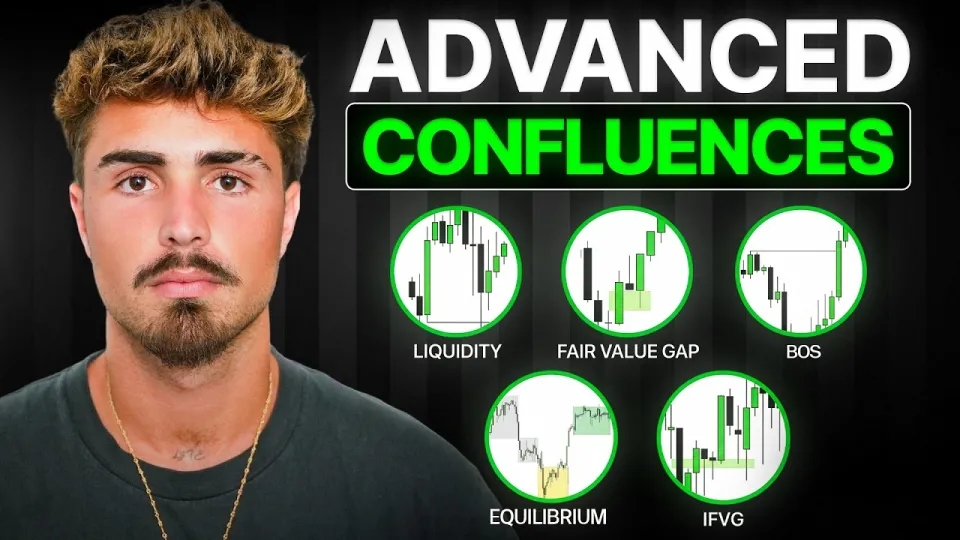
Video: Learn Every Trading Confluence In 18 Minutes
Need articles like this for your video? They help promote it on YouTube and Google — order them in the Telegram bot @sat_sit_bot. Articles with your video embedded are written and posted by the bot itself — on popular topical sites (no ads). Free trial — 50 articles.
· based on the channel TJR
Trading confluences are independent technical signals that align at the same price zone, and stacking at least two of them filters out low-quality setups before you risk capital. The most useful confluence set for intraday charts includes liquidity pools, fair value gaps, inverse fair value gaps, equal highs and lows, and break of structure. TJR's 18-minute breakdown covers each concept in sequence, and the full framework is available through the TJR blueprint.
What a trading confluence actually is and why it matters
A trading confluence is a point where two or more unrelated signals point to the same decision, such as a long entry, a short entry, or a no-trade zone. One signal alone is a guess; two or more independent signals reduce the probability that the move is random noise. The practical rule is simple: if you cannot name at least two reasons for a trade, skip it. This is the core idea behind TJR's video, which walks through every major confluence in about 18 minutes and shows how they stack.
The five core confluences TJR walks through
TJR structures the lesson around five building blocks that appear repeatedly on intraday charts. Each one is a standalone concept, but the value comes from combining them.
- Liquidity. Price tends to seek pools of resting orders, which sit above equal highs and below equal lows. Traders mark these zones because stops and breakout orders cluster there, making them magnets for price.
- Fair value gap (FVG). A three-candle imbalance where the middle candle's range leaves a void between the wicks of the first and third candles. Price often returns to fill part of that gap before continuing.
- Inverse fair value gap (IFVG). When price closes through an FVG and then retests it from the other side, the gap flips roles: former support becomes resistance, or vice versa.
- Equal highs and equal lows (EQH/EQL). Two or more swing points at nearly the same price signal engineered liquidity. A clean sweep of those levels often precedes a reversal.
- Break of structure (BOS). A close beyond a prior swing high or low that confirms a directional shift. BOS is the confirmation layer that tells you the market has chosen a side.
How to stack confluences into a single trade plan
Stacking confluences means waiting for a liquidity sweep, an FVG, and a break of structure to line up before entering. The sequence matters more than the individual signals. A workable checklist looks like this:
- Mark the nearest liquidity pool (equal highs or equal lows) on the session chart.
- Wait for price to sweep that pool and leave a fair value gap behind.
- Require a break of structure in the direction of your intended trade.
- Enter on the retest of the FVG or the inverse FVG, not on the initial impulse.
- Place the stop beyond the swing that created the structure break, and target the next opposing liquidity pool.
This order keeps you out of trades where only one signal is present. TJR's video emphasizes that the goal is not to collect confluences for their own sake but to use them as a filter.
Common mistakes traders make with confluences
Traders often treat confluences as a checklist to force trades rather than a filter to reject them. The most frequent errors are counting correlated signals as independent (for example, an FVG and an order block that occupy the same candle), ignoring the higher-timeframe trend, and entering before the break of structure confirms. Another mistake is marking every minor gap as an FVG; only gaps that sit at a meaningful swing point deserve attention. TJR's breakdown stresses that a confluence you cannot define precisely is not a confluence at all.
What viewers ask most about trading confluences
Viewers of TJR's video repeatedly raise the same practical questions: how many confluences are enough, whether confluences work on lower timeframes, and how to avoid over-analyzing. The short answers are: two independent signals is the minimum, confluences are more reliable when the higher timeframe agrees, and a written checklist prevents analysis paralysis. Many viewers also note that the hardest part is not learning the concepts but applying them consistently without forcing trades. TJR addresses this by framing confluences as a rejection tool first and an entry tool second.
Useful links
- TJR blueprint for full-time trading
- Indicators TJR uses daily
- Funded account raffle entry
- Alpha Futures signup with TJR discount
- Lucid Trading discount
Final thoughts on building a confluence-based trading process
Confluences are only as good as the discipline behind them. The five concepts TJR covers, liquidity, fair value gaps, inverse fair value gaps, equal highs and lows, and break of structure, form a complete filter for intraday setups when used together. Start by marking them on a demo chart for a week before risking real capital. If you want TJR's full system, the blueprint link is the place to start. TJR's channel remains the source for this breakdown and for follow-up lessons on execution and risk.
Key takeaways
- Liquidity pools form above equal highs and below equal lows, acting as magnets for price.
- A fair value gap is a three-candle imbalance where the middle candle's range leaves a void.
- An inverse fair value gap flips a failed FVG into support or resistance after price closes through it.
- Break of structure confirms a shift in market direction when price closes beyond a prior swing point.
- Stacking at least two independent confluences filters low-quality signals and improves risk-reward.
Source: Learn Every Trading Confluence In 18 Minutes · Markdown version
Questions & answers
How many confluences do I need before taking a trade?
Two independent confluences is the practical minimum, such as a liquidity sweep plus a break of structure. More than three rarely adds value and often leads to over-analysis. Focus on signals that are genuinely independent rather than counting the same candle twice.
Do confluences work on lower timeframes like the 1-minute chart?
They can, but lower timeframes produce more noise and false signals. Confluences are more reliable when the higher timeframe trend agrees with the setup. Many traders use a 15-minute or 1-hour chart for structure and a lower timeframe only for entry refinement.
What is the difference between a fair value gap and an inverse fair value gap?
A fair value gap is a three-candle imbalance that price may return to fill. An inverse fair value gap occurs when price closes through the original FVG and then retests it from the opposite side, flipping its role from support to resistance or vice versa.
How do I avoid forcing trades when no confluence is present?
Write a fixed checklist and treat it as a rejection tool, not a to-do list. If two independent signals are not aligned, the trade does not exist. Reviewing your journal for trades taken without confluences is the fastest way to break the habit.